
How Limestone Floor Polishing Works: A Step-by-Step Technical Guide
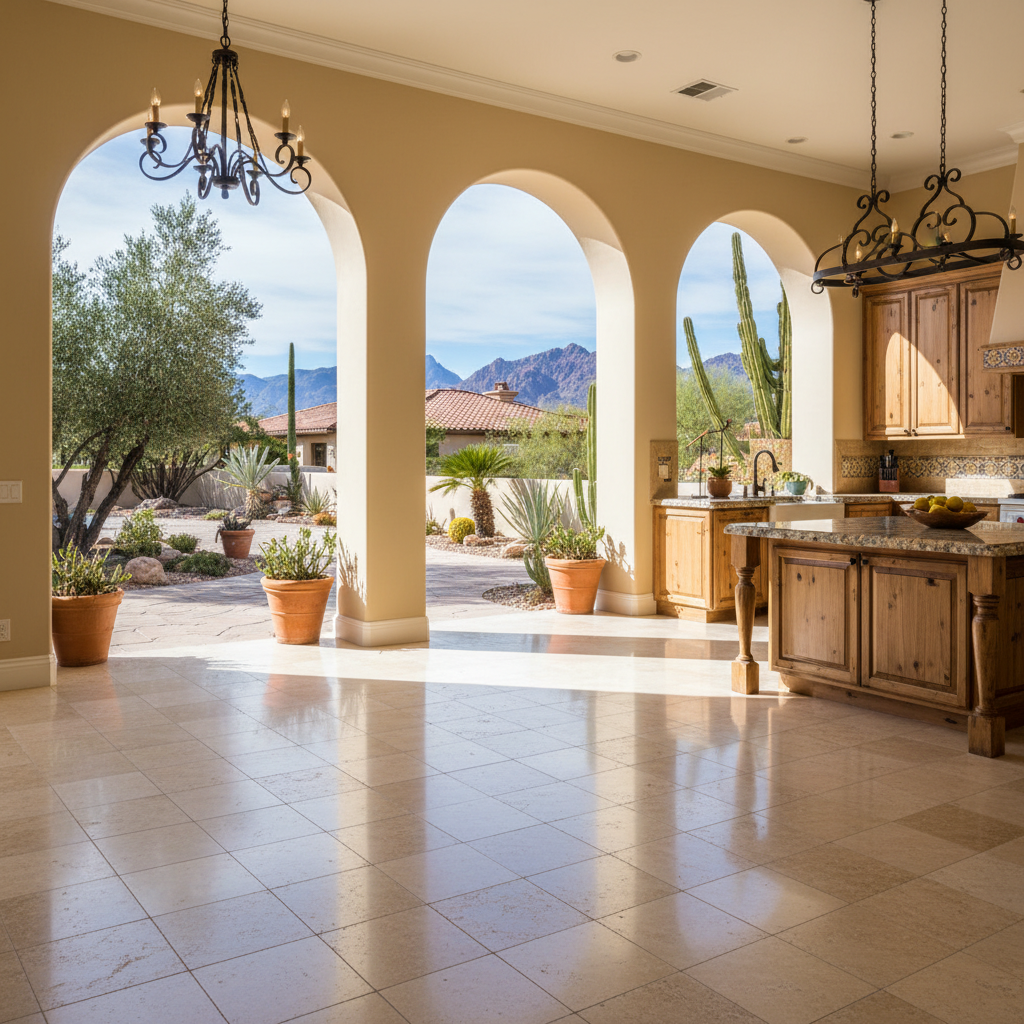
Limestone floor polishing is the one restoration job where the technician's most important decision is knowing when to stop. Marble can be pushed to a mirror. Limestone cannot — and a contractor who promises you a marble-grade gloss on limestone either doesn't understand the stone or is planning to fake the shine with a coating that will wear off in months.
This guide explains the actual mechanics: what happens at each diamond grit, why limestone's sedimentary structure caps its shine, the trade-offs between powder polishing and crystallization, and what a real job looks like hour by hour in a Las Vegas home. It's written for homeowners who want to understand the process before hiring anyone — including us.
If you're looking for cleaning routines, stain triage, and sealing schedules instead, that's covered on our limestone cleaning and restoration service page. This page is about how the polishing work itself is done.
Why limestone can't hold the same gloss as marble
Gloss is not a product you apply — it's an optical property. A stone surface shines when it has been smoothed to the point that light reflects off it uniformly instead of scattering. How far any stone can be smoothed depends on its crystal structure.
Marble started as limestone, then spent geologic time under heat and pressure. That metamorphism fused its calcite into tightly interlocked crystals — a nearly continuous surface that diamond abrasives can refine until it reflects like glass. Limestone never went through that process. Its calcite exists as individual sediment grains — compressed shells, coral, and marine skeletons — held together by natural cement. No matter how fine the abrasive, light still scatters at every grain boundary.
The practical result: limestone has a finish ceiling, and that ceiling depends on the stone's density.
| Limestone Density | Typical Varieties | Realistic Finish Ceiling | Grit Ceiling |
|---|---|---|---|
| Low density (chalky, open-grained) | Many French limestones, shellstone | Smooth matte | 400 grit |
| Medium density | Most Jerusalem stone, Portuguese beige | Satin / soft sheen | 800 grit |
| High density (tight-grained) | Jura beige/grey, some Turkish limestones | Soft gloss (below marble's mirror) | 1,500–3,000 grit |
A good technician taps the stone, checks how fast a water drop absorbs, and runs a small test panel before quoting a finish level. Pushing a medium-density limestone past its ceiling doesn't add shine — it burnishes the harder grains while the softer cement between them stays dull, producing a blotchy, orange-peel look that then has to be honed back out.
Curious how the same process plays out on marble, where the ceiling is a true mirror? Our marble polishing guide covers that stone's full grit sequence for comparison.
The grit progression on limestone, stage by stage
Professional limestone work uses diamond abrasive pads under a weighted floor machine, run wet, moving from coarse to fine. Each stage erases the scratch pattern left by the stage before it. Here is what each grit range actually accomplishes on limestone:
| Stage | Grit | What It Does on Limestone |
|---|---|---|
| Lippage grinding (only if needed) | 50–100 metal-bond | Cuts uneven tile edges flat so the floor becomes one continuous plane. Skipped entirely on floors that were installed flat. |
| Coarse honing | 100–200 resin-bond | Removes deep scratches, wear paths, and the mineral-crusted top layer. This is where years of traffic damage disappear. |
| Medium honing | 400 | Erases the 200-grit scratch pattern and closes the surface. Low-density limestone stops here with a clean matte finish. |
| Fine honing | 800 | Produces the satin sheen most limestone owners are actually after — smooth underfoot, soft light reflection, no glare. |
| Polishing (dense limestone only) | 1,500–3,000 | Brings tight-grained varieties like Jura to a soft gloss. Attempted on soft limestone, this stage causes blotching instead of shine. |
Two adjustments separate limestone technique from harder stones. First, head pressure comes down — limestone at 3 on the Mohs scale cuts fast, and a machine weighted for granite will dish out the softer grains. Second, slurry management matters more. Limestone's soft calcite loads the diamond pads quickly, and thick slurry left on the floor acts like an uncontrolled lapping compound, scratching randomly instead of cutting evenly. Crews rinse and vacuum between every pass.
Powder polishing vs. crystallization: the finishing fork
After the final diamond pass, there are two schools of thought on boosting limestone's sheen. They are not equivalent, and the difference matters more on limestone than on any other stone.
Powder polishing (our default)
Polishing powder — typically an oxalic-acid or tin-oxide compound — is worked into the damp stone under a soft pad. It refines the surface both mechanically and through a mild, controlled reaction with the calcite, deepening the sheen the diamonds established. The result is the stone itself shining, not a layer on top of it. It wears the way stone wears: gradually and evenly, and it's renewable with a maintenance pass.
Crystallization (we rarely recommend it on limestone)
Crystallization sprays an acidic fluorosilicate solution onto the floor and burnishes it with steel wool under a rotary machine. The reaction converts the top microns of calcium carbonate into a harder calcium fluorosilicate skin with a wet-look gloss. On dense marble in commercial lobbies, that trade can make sense. On limestone, the skin sits over a soft, porous body:
- The glassy layer is more brittle than the stone beneath it, so it wears through in patches along traffic lanes rather than fading evenly
- Repeated applications can yellow, especially on cream and gold limestones like Jerusalem stone
- The skin slows vapor movement through the stone — a real issue on Las Vegas slab-on-grade homes where lawn and drip irrigation push moisture up through the concrete, which can leave trapped-moisture haze under the crystallized layer
- Steel wool fragments left in limestone's open pores can rust into pinpoint orange stains
If a bid for your limestone floor leans on crystallization to hit a promised gloss level, ask what happens at the 18-month mark. The honest answer is usually a re-application contract.
What a Las Vegas limestone job looks like, room by room
Here's the sequence for a typical 1,200-square-foot limestone restoration — great room, kitchen, hallway, and two bathrooms — in a Summerlin or Henderson home:
- Setup and containment (first hour): Baseboards, cabinet faces, and adjacent carpet get masked. Doorways to untreated rooms are sealed with plastic — the work is wet, so there's no airborne stone dust, but Las Vegas homes carry enough monsoon-season dust indoors that crews wipe down the work zone first so grit doesn't end up under the pads.
- Water supply: The machines run wet all day. We bring low-mineral rinse water for the final passes because 291 parts per million (ppm) Las Vegas tap water can flash-dry on freshly honed calcite in our low humidity and leave faint mineral ghosting before the sealer ever goes down — a problem crews in soft-water cities never think about.
- Great room and hallway (rest of day one): Open runs are the fast part — each honing pass covers roughly 150–250 square feet per hour. A weighted planetary machine works the field while a technician follows the perimeter with a hand grinder, since the big machine can't reach the last few inches at walls.
- Kitchen (day two, morning): The slowest square footage in the house. Toe-kicks, island corners, and appliance recesses are all hand-tool territory, and grease residue near the range gets degreased before honing so it isn't driven into the open stone.
- Bathrooms (day two, midday): Small rooms, disproportionate time — toilets are pulled or worked around, and thresholds where limestone meets tile get feathered by hand. This is also where we hold the finish at 400–800 grit for traction.
- Final rinse, dry, and sealing (day two, afternoon): The floor is rinsed, wet-vacuumed, and force-dried. In summer, sealer behavior changes — at 110 degrees outside with air conditioning cycling hard, penetrating sealer flashes off faster, so it's applied in smaller sections to keep a wet edge. Two coats, then the house is walkable in hours.
One scheduling note for HOA communities: honing machines produce about as much noise as a vacuum cleaner, but most Summerlin and Henderson HOAs restrict contractor work to roughly 7 a.m.–6 p.m., which is why multi-day limestone jobs are sequenced room-by-room rather than run late.
Timeline and cost by project size
| Project | Typical Size | Working Time | Typical Range |
|---|---|---|---|
| Entry / foyer refresh | 80–150 sqft | Half day | $500–$1,200 |
| Great room hone + seal | 300–500 sqft | 1 day | $1,500–$4,000 |
| Whole-home restoration | 1,000–1,500 sqft | 2–3 days | $5,000+ depending on condition |
Per-square-foot pricing follows the depth of work: honing to a matte or satin finish runs $5–$10 per square foot, while full restoration involving lippage grinding and polishing on dense limestone runs $6–$18 per square foot. The single biggest cost variable is whether the floor needs the coarse grinding stage — a flat, moderately worn floor skips it and lands at the low end.
The first 30 days after polishing
Freshly honed limestone with new penetrating sealer needs a short protective window while the sealer cures inside the pore structure:
- Hours 0–6: Stay off the floor entirely while the sealer's carrier evaporates
- Hours 6–24: Sock and barefoot traffic only; no pets if you can manage it
- Day 1–3: Normal foot traffic; furniture back on felt pads (lifted, never dragged); no rugs yet — they trap curing vapors and can leave a hazy outline
- Day 3–7: Rugs and runners can go back down; dry dust mopping only, no wet cleaning
- Day 7–30: Resume damp mopping with a pH-neutral stone cleaner; at day 30, run a water-drop test in your busiest area to confirm the sealer cured properly — water should bead, not darken the stone
From there, the floor moves into an ordinary maintenance rhythm. Our limestone care service page covers the ongoing routine, and our guide on how often to seal natural stone floors lays out the long-term resealing calendar for Las Vegas conditions.
Frequently Asked Questions
Can limestone be polished to a high gloss like marble?
Usually not. Marble's calcite crystals interlock under metamorphic heat and pressure, so its surface can be refined until it reflects light like glass. Limestone's calcite grains are cemented sediment — light scatters at every grain boundary no matter how fine the abrasive. Dense limestones (Jura, some Jerusalem stone) can reach a soft gloss around 1,500–3,000 grit. Most limestone tops out at a satin sheen near 800 grit, and pushing past that produces a blotchy, burnished look rather than more shine.
What grit sequence do professionals use on limestone floors?
A typical limestone sequence runs 100, 200, 400, then 800 grit with resin-bond diamond pads under a weighted floor machine, run wet. Coarse metal-bond diamonds (50–100 grit) are only used when tiles sit at uneven heights (lippage) and need to be ground flat. Fine grits of 1,500–3,000 are reserved for dense limestone varieties that can actually hold a gloss. The sequence is shorter than marble's because limestone reaches its optical ceiling sooner.
Is crystallization safe for limestone floors?
We generally advise against crystallization on limestone. The process reacts an acidic fluorosilicate compound with the stone's calcium under a steel wool pad, forming a hard glassy skin. On dense marble that skin can be acceptable; on soft, porous limestone it tends to wear through in patches, can yellow, and can trap moisture rising through the slab. Powder polishing or a straight diamond finish achieves the sheen without sealing the stone's pores shut from above.
How long does limestone floor polishing take?
Each honing pass covers roughly 150–250 square feet per hour in open rooms, and a full restoration involves 3–5 passes plus edge work, cleanup, and sealing. A 400-square-foot great room typically takes one full working day. Kitchens and bathrooms run slower because toe-kicks, corners, and fixtures require hand-held tools. A whole-home limestone restoration of 1,000–1,500 square feet usually takes 2–3 days in Las Vegas.
Does polishing make limestone floors slippery?
A honed satin finish — the finish most limestone should receive — keeps more slip resistance than a high-gloss polish because microscopic texture remains in the surface. That is one reason we recommend stopping at 400–800 grit in bathrooms, around tubs, and at pool-adjacent interior floors. If you choose a soft-gloss finish on dense limestone, expect it to behave like any smooth hard floor when wet.
Will polishing grind away the fossils in my limestone?
No. A full limestone restoration removes a fraction of a millimeter of surface material — far less than the thickness of the tile. Fossil shells, coral fragments, and shell beds run through the entire body of the stone, so honing actually sharpens their appearance by cutting a cleaner cross-section through them. Many homeowners tell us their fossils are more visible after restoration than before.
When can I walk on limestone after polishing and sealing?
Light sock or barefoot traffic is fine 4–6 hours after the sealer goes down, and normal foot traffic after 24 hours. Wait 72 hours before laying rugs back down, and hold off on wet mopping for 7 days while the penetrating sealer finishes curing inside the stone's pores. Furniture can be replaced after 24 hours if it slides on felt pads rather than being dragged.
Get an honest finish recommendation for your limestone
The right first step for any limestone floor is a density check and a small test panel — not a promise of gloss over the phone. Night and Day Stone Restoration has honed and polished limestone across the Las Vegas Valley for over 20 years, and we'll tell you plainly what your specific stone can and can't do before any work begins.
Call (702) 809-8436 for a free limestone assessment.
Se habla español: (702) 764-1528