
Travertine Floor Polishing: Complete Guide
Travertine is one of the most misunderstood stones in home restoration. Unlike marble or granite, travertine has natural pits and voids formed by gas bubbles during its creation — and those voids fundamentally change how the stone is cleaned, restored, and polished. Get the process wrong and you grind the filler out of those pits, creating a rougher, more porous surface than you started with.
This guide covers everything you need to know about travertine floor polishing: the difference between honing and polishing, why filled vs. unfilled travertine matters, what professional restoration involves, how much it costs, and how often to schedule service — especially in hard-water cities like Las Vegas.
Travertine vs. Marble: Key Differences for Polishing
Travertine and marble are both calcium carbonate stones — both react to acid, both etch, both can be honed and polished. But travertine behaves differently under diamond abrasives because of its porous structure and natural variation.
| Property | Travertine | Marble |
|---|---|---|
| Natural voids / pits | Yes — must be managed before polishing | No — uniform surface throughout |
| Hardness (Mohs scale) | 3–4 — softer, scratches more easily | 3–5 — similar range, more uniform |
| Porosity | High — absorbs liquids and minerals quickly | Medium — more dense than travertine |
| Acid sensitivity | High — etches on contact with acid | High — same reaction |
| Common finish | Honed (matte/satin) — more practical | Polished (glossy) — more common |
| Hard water impact | Severe — minerals fill pits, cloud surface | Moderate — surface deposits, less pore absorption |
Filled vs. Unfilled Travertine
Before any polishing work begins, a technician must identify whether your travertine is filled or unfilled — this determines the entire restoration approach.
- Filled Travertine
- The natural pits and voids have been filled at the factory with grout, epoxy, or resin before installation. The surface is smooth and uniform. Most indoor residential travertine in Las Vegas homes is filled. Honing and polishing works directly on filled travertine — though old filler may need to be repaired before polishing if it has chipped or worn away.
- Unfilled Travertine
- The natural pits are left open, creating a rustic, textured surface with visible holes. Common in outdoor applications and some Mediterranean-style interiors. Polishing unfilled travertine requires on-site pit filling before mechanical work — otherwise diamond pads abrade the edges of pits inconsistently, creating a rougher surface. Pit filling adds cost and complexity to any unfilled travertine restoration.
Honing vs. Polishing Travertine
For travertine specifically, honing is usually the right choice — and here's why that differs from marble.
| Factor | Honed Travertine | Polished Travertine |
|---|---|---|
| Finish appearance | Smooth, matte to satin — warm, natural look | Glossy, reflective — more formal appearance |
| Scratch visibility | Low — matte surface hides everyday scratches | High — gloss shows scratches and etch marks clearly |
| Hard water deposits | Less visible on matte surface | Very visible — clouding shows clearly on gloss |
| Slip resistance | Better — safer for wet areas | Lower — slippery when wet |
| Maintenance frequency | Less frequent — damage less visible | More frequent — shows wear faster |
| Best application | Floors, high-traffic areas, bathrooms | Accent walls, low-traffic showpiece floors |
| Cost | $4–$10/sqft | $6–$18/sqft |
Our recommendation for Las Vegas travertine floors: Honed finish. The combination of hard water (291 ppm) and desert dust means polished travertine shows clouding and scratching faster than almost anywhere else in the country. A honed finish looks better longer, requires less frequent professional attention, and is safer underfoot.
The Travertine Polishing Process
Professional travertine restoration follows a specific sequence — unlike marble, where you can often go straight to diamond honing, travertine requires assessment and prep steps first.
Step 1: Assessment and Stone Identification
A technician evaluates the travertine type (filled or unfilled), identifies damage (scratches, etch marks, mineral deposits, chipped filler, cracks), assesses the existing finish (honed, polished, or coated with wax/sealers), and determines the correct abrasive sequence. Skipping this step is why DIY travertine polishing frequently creates new problems.
Step 2: Deep Cleaning and Filler Removal
The floor is cleaned with a pH-neutral stone cleaner to remove wax buildup, old sealers, cleaning product residue, and surface contamination. Any topical coatings (wax, enhancers, old penetrating sealers) that would interfere with diamond abrasion are stripped first. Old, deteriorated filler in the pits is cleared out if it's loose or lifting.
Step 3: Pit Filling (Unfilled Travertine or Damaged Filler)
For unfilled travertine or filled travertine with damaged, missing, or discolored filler, a color-matched epoxy or resin is applied to open voids and pits. The filler is allowed to cure, then sanded flush with the surrounding stone surface. This step creates the uniform surface that diamond honing requires — without it, mechanical polishing grinds the edges of pits unevenly.
Step 4: Diamond Honing
Diamond abrasive pads (typically starting at 50–200 grit for heavily damaged stone, 400 grit for light restoration) are worked across the floor with a weighted floor machine. Each pass levels the surface and removes the scratches or mineral deposits from the previous stage. The sequence progresses through increasingly fine grits — 50, 100, 200, 400, 800 — to create a smooth, flat, matte surface.
Step 5: Diamond Polishing (If Requested)
For customers who want a glossy finish, diamond polishing continues from 800 grit through 1,500 and 3,000 grit. Each finer pass creates more light reflectivity. The travertine's natural warm tones and veining become more vibrant as the surface smooths to a mirror-like finish.
Step 6: Crystallization or Sealing
A professional-grade penetrating sealer is applied to fill the travertine's microscopic pores, protecting against stain absorption and slowing hard water deposit formation. For honed travertine, a quality penetrating sealer is essential — the matte surface is more porous than a polished surface and absorbs liquids faster. We back every sealer application with a 30-day guarantee.
DIY vs. Professional: Travertine Polishing Decision Guide
| Situation | DIY Viable? | Why |
|---|---|---|
| Light surface buffing maintenance | Yes | Low-risk, no diamond abrasives needed |
| Surface-level hard water spots | Possibly — with stone-safe remover | Use pH-neutral mineral deposit remover, test first |
| Removing scratches | No | Requires diamond honing sequence — wrong grit = new damage |
| Etch mark removal | No | Etching is surface damage — only diamond abrasives fix it |
| Pit filling | No | Color matching and flush sanding requires professional tools |
| Full floor restoration | No | Weighted floor machines + diamond sequence + pit filling = professional work |
| Routine resealing | Yes — if stone is undamaged | Clean surface, apply penetrating sealer, buff off excess |
Travertine Polishing Cost by Condition
| Floor Condition | Service Needed | Cost Per Sqft |
|---|---|---|
| Good — light dullness, minor haze | Clean + hone + seal | $4–$8 |
| Moderate — visible scratches, hard water buildup | Diamond hone (coarser grits) + seal | $6–$10 |
| Poor — heavy damage, etching, lippage | Diamond grind + hone + polish + seal | $10–$18 |
| Unfilled travertine (add pit filling) | Pit fill + hone + seal | +$2–$4/sqft |
| Crack or chip repair (per repair) | Color-matched epoxy fill + polish flush | $150–$350 |
Typical Project Costs
| Room / Area | Typical Size | Estimated Cost |
|---|---|---|
| Bathroom floor | 50–100 sqft | $300–$800 |
| Entryway / foyer | 100–200 sqft | $600–$1,800 |
| Living room | 300–500 sqft | $1,500–$4,000 |
| Whole home (travertine throughout) | 1,000–2,000 sqft | $5,000–$16,000 |
How Often to Polish Travertine Floors
| Household Type | General Guideline | Las Vegas Adjustment |
|---|---|---|
| Low traffic, adults only | Every 4–5 years | Every 3–4 years (hard water) |
| Family with kids | Every 2–3 years | Every 2 years |
| High traffic / pets | Every 1–2 years | Annually |
| Commercial / rental | Annually or more | Annually minimum |
The water drop test applies to travertine too: drop a small amount of water on your floor and wait 4 minutes. If the travertine darkens where the water sits, the sealer has failed and resealing is overdue — don't wait for professional polishing, reseal now and schedule restoration within the year. Read our guide on how often to seal natural stone floors for a complete maintenance calendar.
Las Vegas Travertine: A Special Case
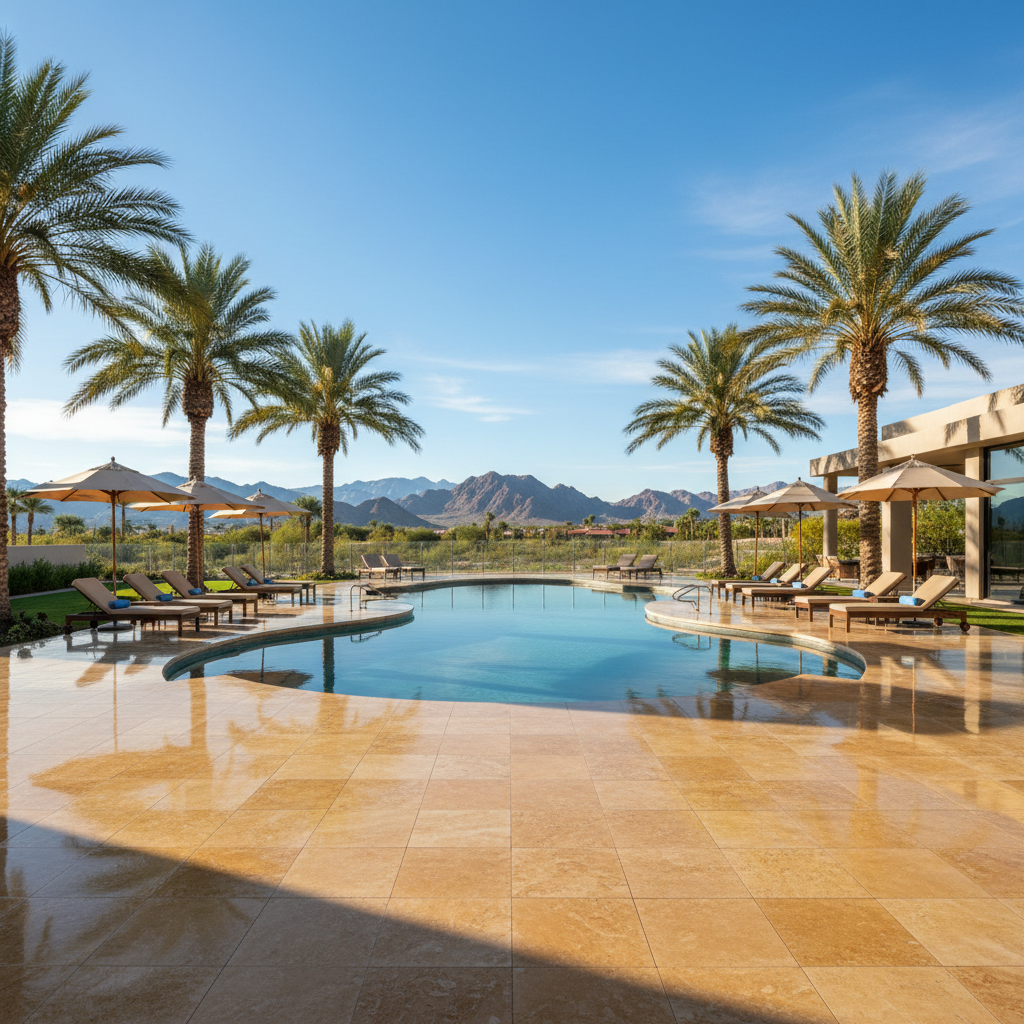
Las Vegas creates conditions that accelerate travertine deterioration faster than nearly any other American city:
- Hard water (291 ppm) — Las Vegas tap water is among the hardest in the country. Every drop that evaporates on travertine leaves a calcium and magnesium deposit. Over months, these deposits fill the stone's pores, cloud the surface, and work into pits — requiring diamond honing to remove, not just chemical treatment.
- Desert dust — Mojave fine particulate infiltrates homes constantly. Tracked across travertine floors, it acts as a fine abrasive that micro-scratches the surface with every step. Regular dust mopping is not optional in Las Vegas — it's the most important maintenance step for travertine longevity.
- Extreme heat — Outdoor travertine around pools, patios, and driveways in Las Vegas experiences thermal expansion and contraction that can pop filler from pits and open hairline cracks. Outdoor travertine typically needs attention every 1–2 years.
- Low humidity — Las Vegas' dry air evaporates moisture quickly, accelerating hard water deposit formation on travertine surfaces.
For professional travertine polishing in Las Vegas, see our Las Vegas travertine restoration service page for pricing, scheduling, and service area details.
Frequently Asked Questions
Q: What is travertine floor polishing?
A: Travertine floor polishing is a mechanical diamond abrasive process that smooths the stone surface and restores shine. For travertine specifically, it often includes pit filling before the diamond work begins to create a uniform surface. The process removes scratches, mineral deposits, and etch marks and ends with professional sealing.
Q: What is the difference between honing and polishing travertine?
A: Honing uses diamond abrasives up to 400–800 grit to create a smooth, matte or satin surface — no shine. Polishing continues to 1,500–3,000 grit for a glossy finish. Most travertine floors are better served by honing — the matte finish hides scratches, resists hard water showing, and is safer underfoot than polished travertine.
Q: How much does travertine floor polishing cost?
A: Professional travertine honing and polishing costs $4–$8 per square foot for floors in good condition. Heavy restoration with grinding and pit filling runs $10–$18 per square foot. A typical 300–500 sqft living room runs $1,500–$4,000 total. Call (702) 809-8436 for a free written estimate.
Q: How often should travertine floors be polished?
A: Every 2–5 years depending on traffic and maintenance. Las Vegas homes with hard water (291 ppm) typically need restoration every 2–3 years — the hard water accelerates mineral deposit buildup inside travertine's pores far faster than in soft-water cities.
Q: What is the difference between filled and unfilled travertine?
A: Filled travertine has its natural pits pre-filled at the factory — smooth and uniform. Unfilled travertine has open pits — a rustic, textured look. Polishing unfilled travertine requires on-site pit filling first, adding cost and complexity. Most indoor Las Vegas residential travertine is the filled variety.
Q: Can I polish travertine floors myself?
A: Light maintenance buffing can be done DIY. Anything beyond that — scratch removal, etch mark repair, pit filling, mineral deposit removal — requires professional diamond equipment. Travertine's porosity and natural voids make DIY polishing riskier than marble or granite.
Q: What causes travertine to lose its shine?
A: The main causes are hard water mineral deposits (especially severe in Las Vegas), etching from acidic substances (wine, citrus, cleaning products), foot traffic micro-scratches, and desert dust abrasion. In Las Vegas, hard water is almost always the primary culprit behind dull travertine.
Q: Does travertine polishing fix pits and holes?
A: Yes — if pit filling is included in the service. Diamond honing alone cannot fill voids. Professional travertine restoration includes color-matched filler application to open pits before honing, creating a uniform surface. Ask your contractor whether pit filling is included or billed separately.
Schedule Your Travertine Restoration
Night and Day Stone Restoration has over 20 years of experience polishing travertine floors throughout Las Vegas, Henderson, Summerlin, and the surrounding valley. We use professional-grade diamond equipment, provide color-matched pit filling, and back every sealer application with our 30-day guarantee.
Call (702) 809-8436 for a free travertine assessment.
Se habla espanol: (702) 764-1528