
Travertine Cleaning, Sealing & Restoration
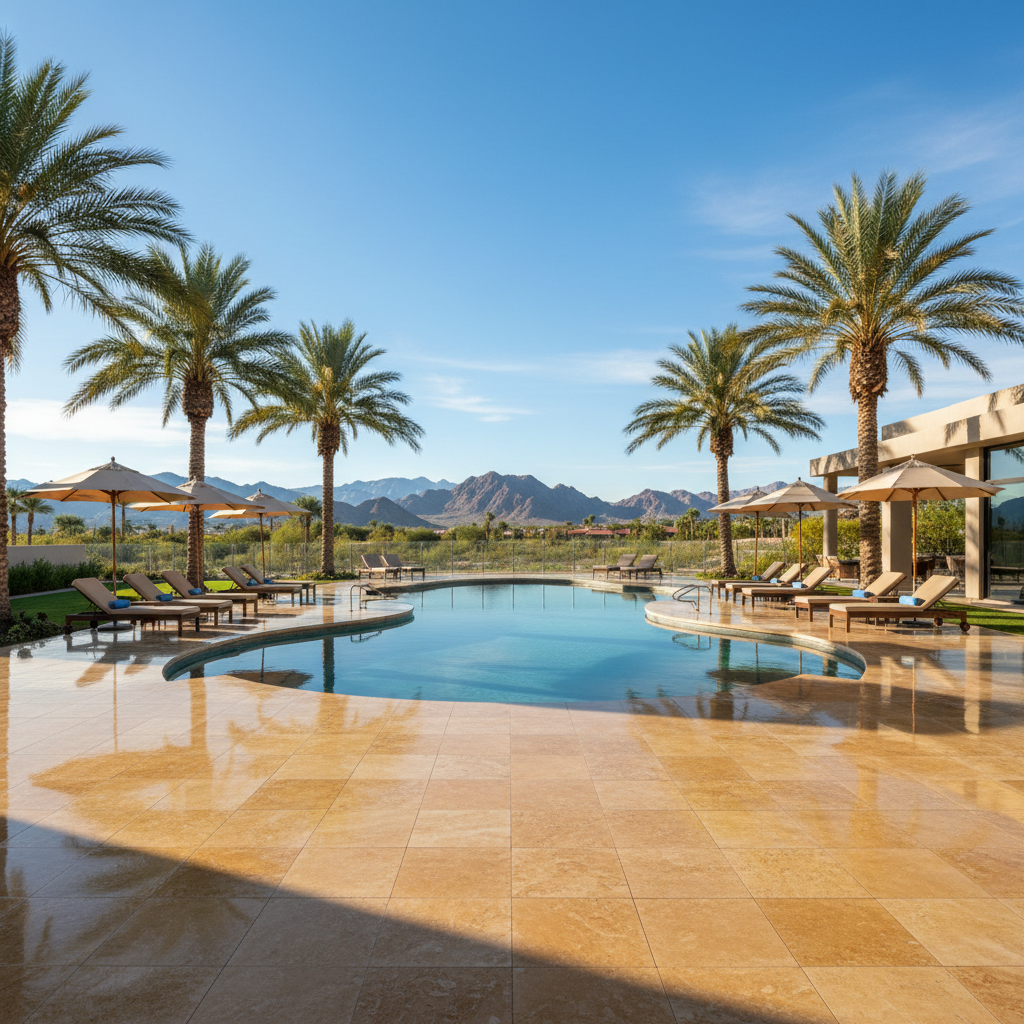
Travertine is a sedimentary limestone formed by mineral deposits in natural springs. Its warm, earthy tones and naturally textured surface make it one of the most popular flooring choices for homes in the American Southwest. But travertine's naturally porous structure makes it one of the most maintenance-sensitive natural stones.
Without proper sealing and care, travertine absorbs hard water minerals, stains from spills, and dirt from foot traffic — all of which dull its natural beauty over time. Professional travertine restoration reverses this damage completely.
Our Travertine Services
| Service | What's Involved | Starting Price |
|---|---|---|
| Deep cleaning | Professional extraction cleaning to remove embedded dirt and minerals | $4-$6/sqft |
| Cleaning + sealing | Deep cleaning followed by penetrating sealer application | $4-$10/sqft |
| Honing (matte restoration) | Diamond honing to smooth and refresh the surface | $5-$10/sqft |
| Polishing (gloss restoration) | Diamond polishing for a high-shine finish | $6-$12/sqft |
| Heavy restoration | Grinding + honing + polishing for severely damaged travertine | $10-$18/sqft |
| Hole and pit filling | Epoxy fill of natural travertine voids and pitting | $3-$5/sqft |
| Grout repair | Re-grouting deteriorated or discolored grout lines | $2-$4/sqft |
| Sealing (standalone) | Penetrating sealer with 30-day guarantee | $0.50-$2/sqft |
The Travertine Restoration Process
- Assessment: Evaluate travertine condition, identify damage types, check existing sealer status with water drop test
- Old sealer removal: Chemical stripping of degraded or buildup sealers if necessary
- Deep cleaning: Professional extraction to remove embedded dirt, minerals, and organic growth from pores
- Hole and pit filling: Natural voids and surface pitting filled with color-matched epoxy (optional based on preference)
- Diamond honing or polishing: Progressive diamond abrasives smooth the surface and restore the chosen finish level
- Grout repair: Damaged or discolored grout lines repaired or replaced as needed
- Sealing: Professional penetrating sealer applied and backed by our 30-day guarantee
Common Travertine Problems We Solve
- Hard water mineral buildup — white, cloudy deposits that dull the surface and penetrate pores
- Gradual darkening from years of absorbed dirt and cleaning residue
- Dull, worn finish in high-traffic areas (entryways, kitchens, hallways)
- Etching from acidic spills (wine, citrus, cleaning products)
- Mold and mildew in bathroom and shower travertine
- Grout deterioration — cracking, crumbling, or severe discoloration
- Failed or yellowed sealers that trap dirt and look worse than unsealed stone
Travertine Sealing: The Most Important Protection
Sealing is non-negotiable for travertine. Its high porosity means unsealed travertine absorbs liquids, minerals, and dirt aggressively. Professional sealing fills those pores and dramatically reduces absorption.
Sealer Types for Travertine
| Sealer Type | How It Works | Longevity | Appearance Change |
|---|---|---|---|
| Penetrating (impregnating) | Absorbs into stone pores, creates subsurface barrier | 3-5 years | None — stone looks the same |
| Color-enhancing | Penetrates pores while deepening natural color tones | 2-4 years | Richer, warmer tones |
| Topical | Sits on surface as a visible coating | 1-3 years | Adds gloss or matte sheen |
We recommend penetrating sealers for most travertine installations. They provide the longest protection without altering the stone's natural appearance.
How Often to Seal Travertine
| Area | Recommended Frequency |
|---|---|
| Bathroom floors and showers | Every 1 year |
| Kitchen floors | Every 1-2 years |
| Entryways and hallways | Every 1-2 years |
| Living rooms and bedrooms | Every 2-3 years |
| Outdoor patios and pool decks | Every 1 year |
The Water Drop Test
Check your sealer status in 30 seconds:
- Sprinkle water on your travertine
- Wait 5-10 minutes
- Water beads on surface → Sealer is working
- Water slowly absorbs → Sealer is thinning, reseal soon
- Water absorbs quickly → Sealer has failed, reseal immediately
Full guide: How often to seal natural stone floors
Travertine Care Between Professional Services
Daily
- Dust mop with dry microfiber to remove abrasive grit
- Blot spills immediately — especially acidic liquids (wine, citrus, coffee)
Weekly
- Damp mop with pH-neutral stone cleaner
- Dry the floor after mopping to prevent mineral deposits
- Clean bathroom travertine with stone-safe cleaners (NOT bathroom spray cleaners)
What to Never Use on Travertine
- Vinegar — acid etches travertine on contact (this is the #1 mistake)
- Bleach or ammonia — degrades sealers and can discolor stone
- Generic floor cleaners — most are too acidic or alkaline for travertine
- Steam mops — heat and concentrated moisture damages sealers
- Abrasive pads — scratches the relatively soft surface
Filled vs Unfilled Travertine
- Filled Travertine
- Natural holes and voids are filled with epoxy or cement at the factory, creating a smoother surface. Easier to clean and maintain. The fills can deteriorate over time and may need professional re-filling during restoration.
- Unfilled Travertine
- Natural holes and voids are left open, creating a more rustic, textured appearance. Requires more careful cleaning (dirt collects in voids). Popular for outdoor applications and rustic interior design. Can be professionally filled later if you change your preference.
Restoration vs Replacement
| Option | Cost Per Sq Ft | 400 Sq Ft Living Room | Timeline |
|---|---|---|---|
| Professional restoration | $4-$18 | $1,600-$7,200 | 1-2 days |
| Full travertine replacement | $17-$35 | $6,800-$14,000 | 2-4 weeks |
Restoration saves 60-85% compared to replacement. Full analysis: Stone restoration vs replacement cost guide
Frequently Asked Questions
Q: How much does travertine cleaning and sealing cost?
A: Professional travertine cleaning and sealing costs $4-$10 per square foot. Deep cleaning alone starts at $4/sqft. Standalone sealing runs $0.50-$2/sqft. Full restoration with honing or polishing costs $6-$18/sqft depending on condition.
Q: Can you remove hard water stains from travertine?
A: Yes. Professional diamond honing removes hard water mineral deposits that have penetrated the travertine surface. For lighter deposits, deep cleaning with stone-safe mineral removers is effective. Read our hard water stain removal guide for DIY methods between professional services.
Q: Can vinegar clean travertine?
A: No. Vinegar is acidic and will etch travertine, causing permanent dull spots. Always use a pH-neutral stone cleaner formulated for natural stone. Read our travertine floor care guide for safe cleaning methods.
Q: How often should travertine be professionally cleaned?
A: Every 2-4 years for most residential installations. High-traffic areas and bathrooms may need attention every 1-2 years. Sealing should happen more frequently — every 1-2 years.
Q: Is travertine hard to maintain?
A: Travertine requires more attention than granite or quartz because it's porous and acid-sensitive. But with proper sealing and a simple daily dust-mopping routine, travertine maintenance is manageable. The key is consistent sealing and immediate spill cleanup.
Q: Can travertine floors be polished to a high gloss?
A: Yes. Travertine can be finished to a honed (matte), satin, or high-gloss polish. The polishing process is similar to marble. High-gloss travertine showcases the stone's natural warmth and veining beautifully.
Schedule Your Travertine Restoration
Over 20 years of travertine restoration experience. Professional diamond equipment. 30-day sealer guarantee on every application.
Call (702) 809-8436 for a free travertine assessment.
Se habla espanol: (702) 764-1528